Demystifying Live Tennis API Access for Developers and Sports Platforms
Building a modern sports application, betting portal, or fan engagement platform requires real-time accuracy, high reliability, and deep coverage across global tournaments. Tennis poses unique operational challenges because match activity happens continuously across thousands of events annually, from grand slams to local qualifiers. Implementing a robust LiveTennisAPI ensures that your platform delivers immediate score updates, detailed historical trends, and live betting market odds to users without latency issues.
Choosing the right partner for your live data feed determines how effectively your platform scales during peak tournament traffic. Real-time updates via modern transmission protocols ensure that end users experience matches as they happen on the court.
Understanding the Scope of Global Tennis Data Coverage
A comprehensive tennis data feed must span beyond just top-tier events. To keep user retention high throughout the entire calendar year, platforms need access to match dynamics from multiple professional tiers:
- ATP Tour events including Grand Slams, Masters 1000, and ATP 500/250 events
- WTA Tour matches covering all women elite international tournaments
- Challenger Tour competitions featuring rising talent around the globe
- ITF Men and Women circuits offering year-round high-volume match coverage
By capturing scores, statistics, and player metrics across all four main circuits, developers can maintain an active platform regardless of off-season gaps in major tournaments.
Essential Features of Modern Tennis Data Feeds
Integrating sports metrics into your codebase demands flexible distribution methods tailored to different infrastructure needs.
REST Architecture for On-Demand Querying
RESTful endpoints remain the industry standard for pulling static data such as tournament schedules, historical player records, and head-to-head statistics. Querying historical database records allows developers to display past match outcomes, season trends, and performance breakdown over multi-year periods.
WebSocket Connections for Real-Time Precision
For live scoring, point-by-point tracking, and live odds shifts, standard REST querying introduces unnecessary latency. Real-time streaming via WebSocket channels establishes a persistent connection, pushing instant data triggers directly to your front end the moment a point concludes or an odd updates.
Advanced Predictive Analytics and AI Insights
Modern platforms require more than raw scoreboards. Incorporating machine learning models and artificial intelligence allows services to output real-time win probabilities, momentum metrics, and live match predictions. These analytical overlays significantly boost user engagement and dwell time.
Evaluating Tiered Plans and Data Accessibility Options
Different projects require distinct data depth based on their audience size and platform goals. Flexible tier structure allows startups to prototype without upfront expenses, while scaling platforms can upgrade for enterprise-grade features.
Free Entry Tier for Testing and Basic Scores
For early-stage projects or simple scoreboard applications, accessing free live score endpoints provides essential match tracking capabilities without financial overhead. Developers can validate concepts, test network reliability, and build user interfaces before committing to paid infrastructure.
Historical Metrics for Analytics Platforms
For platforms focusing on statistical analysis, player profile backtests, and performance trends, dedicated historical database plans provide years of match results and player head-to-head records at accessible pricing points.
Market Odds Integration for Sports Gaming
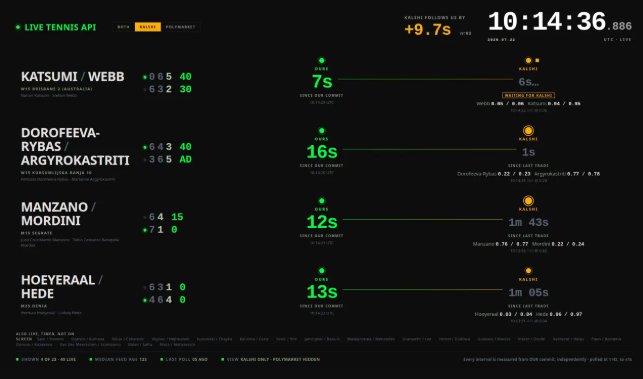
Live odds tracking requires continuous polling across major bookmakers. Specialized market odds feeds deliver real-time pricing shifts for pre-match and in-play markets, enabling platforms to offer comprehensive betting insights and comparison tools.
Full-Scale Live Data with AI Engine Access
High-volume applications requiring ultra-low latency, full WebSocket feeds, and proprietary AI win-probability models benefit from complete API access. This tier caters to enterprise-grade platforms demanding instant execution and rich statistical overlays.
Key Technical Reasons to Upgrade Your Sports Infrastructure
When selecting your API service provider, infrastructure quality dictates user experience. Several factors distinguish elite data feeds:
- Sub-second Latency: Instant delivery of point outcomes ensures your live scoreboard never falls behind live TV broadcasts or user updates.
- Unified Schema: Standardized JSON responses simplify integration across ATP, WTA, Challenger, and ITF match data, drastically reducing development cycles.
- High Availability and Uptime: Robust server architecture prevents service drops during peak grand slam events when traffic surges dramatically.
- Comprehensive Documentation: Clear endpoint guidelines, code samples, and active technical support reduce onboarding friction for engineering teams.
Conclusion
Integrating a fast, reliable, and scalable tennis data feed is crucial for building next generation sports software. By combining free livetennisapi.com score access, historical archives, live market odds, and cutting edge AI predictive models over both REST and WebSocket, platforms can tailor their data pipeline to their exact technical requirements. Choosing a flexible data partner guarantees that your application stays ahead of the game with accurate updates across every level of professional tennis.


